




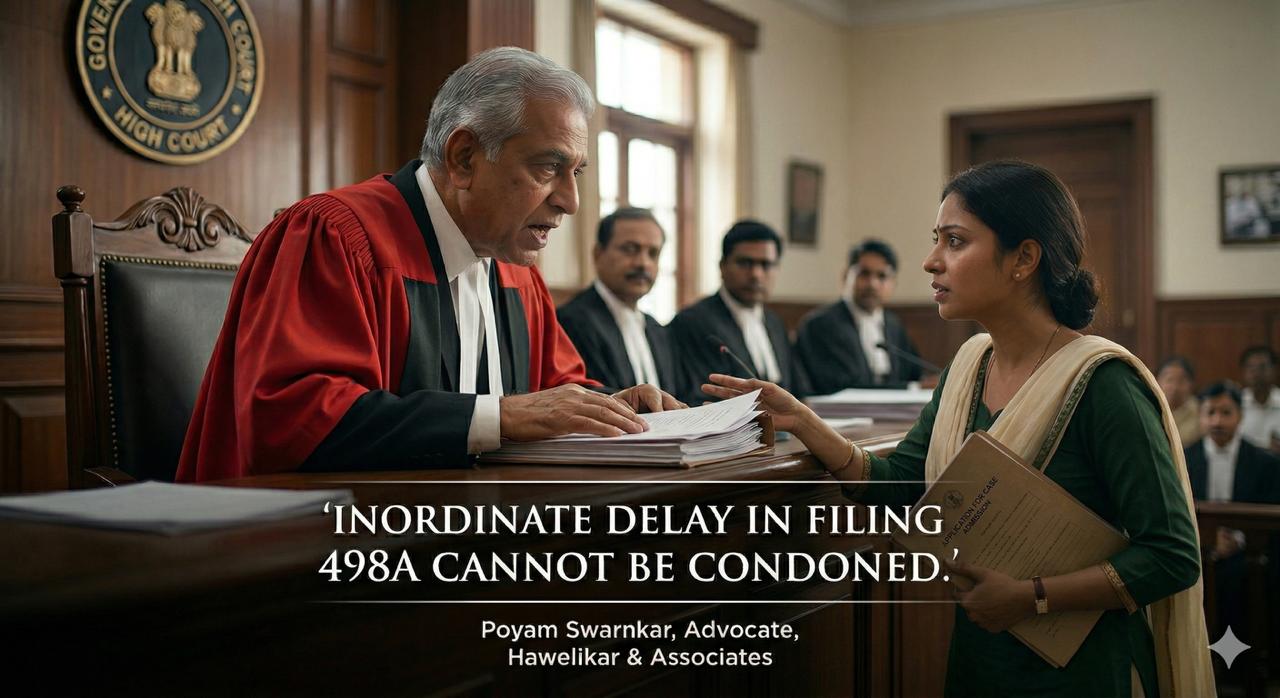
Supreme Court Quashes 498A and Dowry
Proceedings Against In-Laws: A Stance Against Vague Allegations and Unexplained
Delays
By Poyam Swarnkar, Advocate
Hawelikar & Associates, Advocates
In the light
of Matrimonial disputes missuse of criminal provisions and implicating the
Husband’s entire family has become a growing concern for the Judiciary. In a
recent non-reportable judgment dated 25.03.2026 in the case of Charul
Shukla v. State of U.P. & Others (2026 INSC 297), the Apex Court firmly
intervened to Quash Criminal Proceedings against a sister-in-law and
parents-in-law.
Bench
comprising Justices B.V. Nagarathna and Ujjal Bhuyan, this judgment serves as a
vital precedent reinforcing that vague, omnibus allegations and massive,
unexplained delays cannot be used as a tool for harassment
Background:
-
The case
arose from a marriage solemnised on April, 2017, over six years later, on
November, 2023, the complainant filed an FIR against her husband, and in laws. The
FIR invoked severe charges, including Section 498A (cruelty), Section 323
(voluntarily causing hurt), Section 313 (causing miscarriage without woman's
consent) of the IPC, and Sections 3 and 4 of the Dowry Prohibition Act wherein
the Complainant alleged an demand for Dowry, unwanted sexual conduct by
father-in-law and further claimed that
in July 2017, her in-laws and husband physically assaulted her, leading to a
miscarriage.
The
Allahabad High Court had previously declined to quash these proceedings, noting
that the FIR disclosed cognisable offences Aggrieved, the sister-in-law and
parents-in-law approached the Supreme Cour.
The Supreme
Court undertook a thorough review of the chargesheet which had already dropped
the Section 313 IPC (miscarriage) charge. The Court allowed the Appeals and
quashed the proceedings based on several critical legal pillars.
The Court
dismissed the allegations of cruelty and dowry harassment due to a complete
lack of supporting evidence, emphasizing that mere unsubstantiated claims are
insufficient to initiate criminal proceedings. It further noted a significant
and unexplained delay of over six years in filing the complaint, which
undermined its credibility in light of the principle that the law aids the
vigilant. The Court also rejected the allegation of forced miscarriage due to
absence of medical corroboration. Additionally, vague and general accusations
of outraging modesty against the father-in-law, without specific details or
evidence, were held to be legally unsustainable.
Quoting
judicial precedent, the Apex Court highlighted the growing tendency to misuse
provisions like Section 498A of the IPC as a tool for personal battle. The
Court cautioned that generalized and sweeping accusations against a husband's
family cannot form the basis for criminal prosecution.
Relying
heavily on the landmark guidelines laid down in State of Haryana v.
Bhajan Lal, the Apex Court concluded that the allegations were so
inherently improbable that no prudent person could find sufficient grounds to
proceed against the accused
Taking into
account that the parents-in-law are senior citizens (aged 73 and 71) and the
sister-in-law is a highly educated professional living separately, the Court
held that it was neither expedient nor in the interest of justice to allow the
prosecution to continue. Consequently, the FIR and the ensuing criminal
proceedings were quashed against the appellants.